You want to know what a full motorcycle service actually covers and why it matters for your safety and bike life. A full service inspects and fixes everything from the engine and fluids to brakes, tyres, drive system, suspension, steering, and electronics, so your bike is safe and reliable on the road. I’ll walk you through the key checks and simple reasons they matter, so you can spot issues early and make smarter choices at the garage.
Expect oil and filter changes, a careful look at the engine and transmission, brake pad and fluid checks, chain or belt adjustment, tyre and wheel inspection, suspension and steering assessment, and an electrical diagnostic if needed. I’ll also point out what to ask your mechanic and what to look for on the service sheet so you get clear value for your time and money.
Key Takeaways
- A full service covers major systems to keep your bike safe and reliable.
- Mechanics check fluids, brakes, drive system, suspension, tyres, and electronics.
- Ask for clear documentation so you know what was inspected and fixed.
Overview of a Motorcycle Full Service
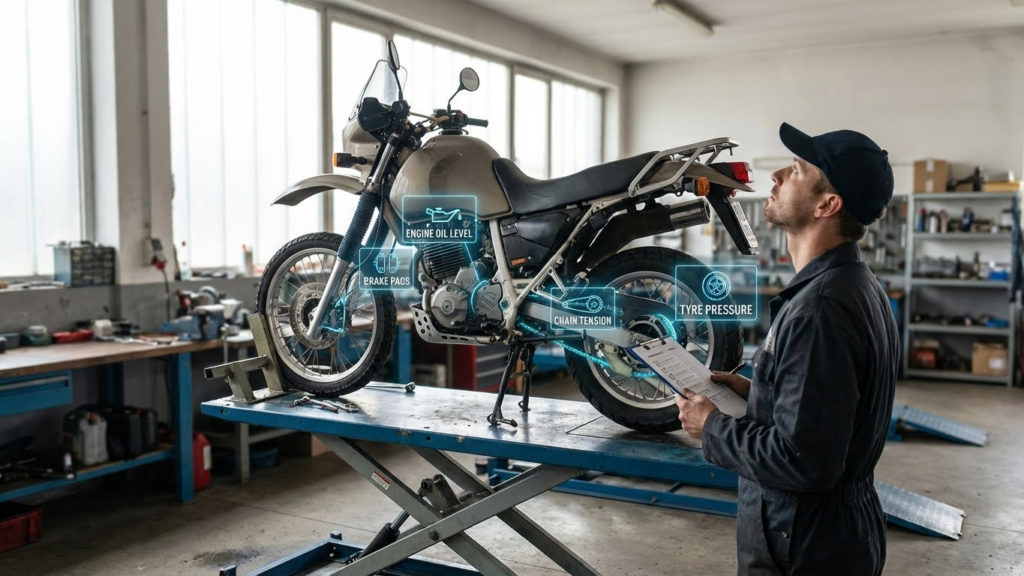
I describe what a full service covers, when to have it done, and how it differs from routine checks. Expect a thorough inspection, fluid and filter changes, and adjustments to ensure safety and reliability.
Definition of Full Service
I call a full service a complete inspection and maintenance session that covers the whole bike. It typically includes engine oil and oil filter change, air filter replacement or cleaning, spark plug inspection or replacement, and fuel system checks.
I also inspect brakes (pads, discs, fluid), suspension (fork seals, shock condition), drive system (chain, sprockets, belt or shaft), and steering components. Electrical checks include battery health, lights, horn, and charging system tests.
I top up or replace fluids — brake, coolant, and final drive oil if needed. I tighten and torque fasteners, check for leaks, and road-test the bike to confirm fixes. I record all work and note items needing future attention.
Recommended Service Intervals
I follow manufacturer service intervals in the owner’s manual as the primary guide. Typical intervals: minor checks every 1,000–3,000 miles (1,600–4,800 km), intermediate services around 6,000–8,000 miles (9,500–12,800 km), and full services every 12,000–15,000 miles (19,000–24,000 km) or once per year for many bikes.
I adjust intervals for riding style and conditions. Heavy use, short trips, towing, or dusty environments shorten service intervals. I also watch component condition rather than only mileage — chains, brake pads, and tires may need attention sooner.
Difference Between Full Service and Basic Maintenance
Basic maintenance covers quick checks and simple tasks you can do or get done fast: oil top-ups, fluid level checks, tire pressure, and visual brake inspections. These tasks keep the bike safe between larger services.
A full service goes deeper. It replaces filters, inspects internal components, adjusts valves if needed, and performs diagnostic checks on the electrical and fuel systems. It also includes road testing and documented checks against the service schedule.
To decide which you need, I consider mileage, time since last full service, warning lights, and unusual noises or handling issues. If more than routine checks are required or if the bike is close to the manufacturer’s full service interval, I recommend a full service.
Essential Engine and Transmission Checks
I focus on parts that keep the engine running smoothly and the transmission shifting correctly. These checks reduce breakdown risk and help the bike use less fuel.
Oil and Oil Filter Replacement
I drain the old oil and replace the oil filter to keep engine parts lubricated and cool. Fresh oil preserves piston rings and bearings, and I always match the oil grade to the manufacturer’s spec printed in the service manual. I also inspect the oil pan, drain plug, and filter housing for leaks or damage while the bike sits on the stand.
After refilling, I run the engine to check pressure and look for leaks. I record oil type, quantity, and the next change interval in the service log. For guidance on oil grades and intervals, I often reference manufacturer pages like Honda or Yamaha for exact specs.
Spark Plug Inspection and Replacement
I remove each spark plug and check the electrode, porcelain, and gap. A healthy plug shows light tan deposits; heavy black carbon, oil fouling, or melted electrodes indicate problems like rich mixture, oil burning, or overheating. I measure the gap with a feeler gauge and adjust or replace plugs to the exact gap the manual lists.
I use OEM or high-quality replacement plugs and tighten them to the torque spec to avoid thread damage. After installation, I perform a compression or leak-down check if plugs showed severe fouling. For correct part numbers and torque values I consult the bike’s service manual or trusted sources such as manufacturer support pages.
Valve Clearance Adjustment
I check valve clearances with the engine cold, using feeler gauges to compare measured gaps against spec. Too-tight valves cause hard starting and burnt valves; too-loose valves cause noise and poor performance. I follow the service sequence—remove covers, rotate the engine to TDC, and measure each shim or tappet.
If adjustments are needed, I replace shims or adjust tappets to the spec and recheck clearances. I also inspect cam lobes and rocker arms for wear. Valve work affects idle, power, and fuel economy, so I log the measured clearances and next check interval in the maintenance record.
Air Filter Cleaning or Replacement
I inspect the air filter for dirt, oil, and damage. Foam filters get cleaned and oiled; paper filters get replaced when clogged. A restricted filter reduces airflow and makes the engine run rich, so I swap or service the element based on condition, not just time.
I clean the airbox and check intake boots for cracks or leaks that can admit unfiltered air. After reinstalling the filter, I ensure the seal is tight and fasteners are secure. For filter care tips and replacement intervals, I refer to parts suppliers and manufacturer maintenance guides.
Brake System Inspection and Maintenance
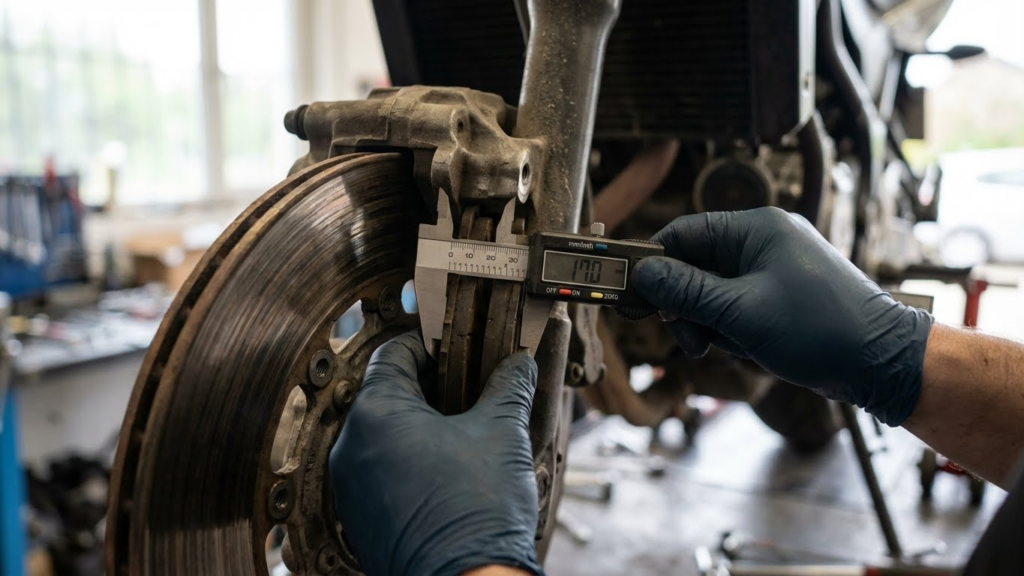
I focus on the parts that affect stopping power, pedal feel, and leak-free operation. I inspect pads and rotors, test fluid quality and level, and examine lines and fittings for damage or wear.
Brake Pad and Disc Assessment
I check pad thickness against the manufacturer’s minimum. If the pads measure close to or below the limit, I list them for replacement. I also look for uneven wear, glazing, or contamination from oil or grease.
For discs (rotors), I measure runout and thickness with a micrometer or caliper. I check for scoring, cracking, and heat spots that can warp or reduce friction. If the rotor is under the minimum thickness or has deep grooves, I recommend machining only if the remaining thickness will meet spec; otherwise I replace it.
I inspect caliper pistons and slide pins for seizure and uneven pad contact. I clean caliper surfaces, apply proper grease to slides, and make sure pad hardware and anti-rattle clips are in place. I ride-test to confirm consistent bite and no pulsing through the lever or pedal.
Brake Fluid Flush and Replacement
I check the brake fluid reservoir level and the fluid color. Dark, cloudy, or milky fluid indicates moisture or contamination and signals a flush.
I follow DOT-spec recommendations and local service intervals. I bleed the system from the farthest caliper to the master cylinder using fresh fluid until I see clear, bubble-free fluid at the caliper. I avoid mixing DOT types; if the system requires DOT 4, I use DOT 4 only.
I note fluid boiling-point degradation caused by absorbed moisture. If the fluid tests below the recommended boiling point or the bike shows reduced lever firmness under hard braking, I replace the fluid. I also inspect master cylinder seals and reservoir cap for leaks or damage.
Brake Line Condition Check
I visually inspect all brake lines for cracks, bulges, chafing, or hardening. Rubber hoses that feel stiff or show surface cracking need replacement.
I check fittings, banjo bolts, and crush washers for corrosion and tightness. For bikes with braided stainless lines, I look for frayed outer braid or loose termini and confirm proper routing and clamps.
I perform a pressure test by squeezing the lever or pedal while observing for hose swell or fluid seepage. Any sign of soft lever travel with firm calipers suggests internal hose collapse or air; I replace suspect lines and re-bleed the system to restore proper feel and safe stopping performance.
Chain, Belt, and Drive System Service
I check the final drive for wear, tension, and proper operation. I look for signs that affect safety and performance, like slack, missing teeth, glazing, or leaks.
Chain Lubrication and Adjustment
I clean the chain with a degreaser and a soft brush to remove grit that wears sprockets. After drying, I apply a motorcycle-specific chain lube to the inside of the chain while rotating the wheel to coat rollers and pins evenly.
I measure chain slack at the midpoint between sprockets and compare it to the manufacturer’s spec. If the slack is too much, I adjust the rear axle or adjusters to get the correct tension without over-tightening. I also check sprocket teeth for hooked, chipped, or worn profiles; I replace sprockets if teeth are badly worn or if the chain shows tight links.
I inspect master links, O-ring or X-ring seals, and the chain for rust or stiff links. I record the chain condition and note when the next lube or adjustment is due.
Drive Belt and Sprocket Inspection
I visually inspect belt-drive systems for cracks, fraying, or missing teeth in the belt and for oil or grease contamination. I run my hand (without touching a hot belt) close to the belt to feel for glazing or ridges that signal wear.
I check belt tension against the spec and look for pulleys or sprockets with uneven wear, wobble, or damaged teeth. For shaft drives I inspect the final drive housing for leaks, check the universal joint or drive flange for play, and verify gear oil level and condition where serviceable.
I replace belts, sprockets, or seals when wear or damage exceeds safe limits, and I note service intervals for belts and shaft gear oil so owners know when to return.
Suspension and Steering Components
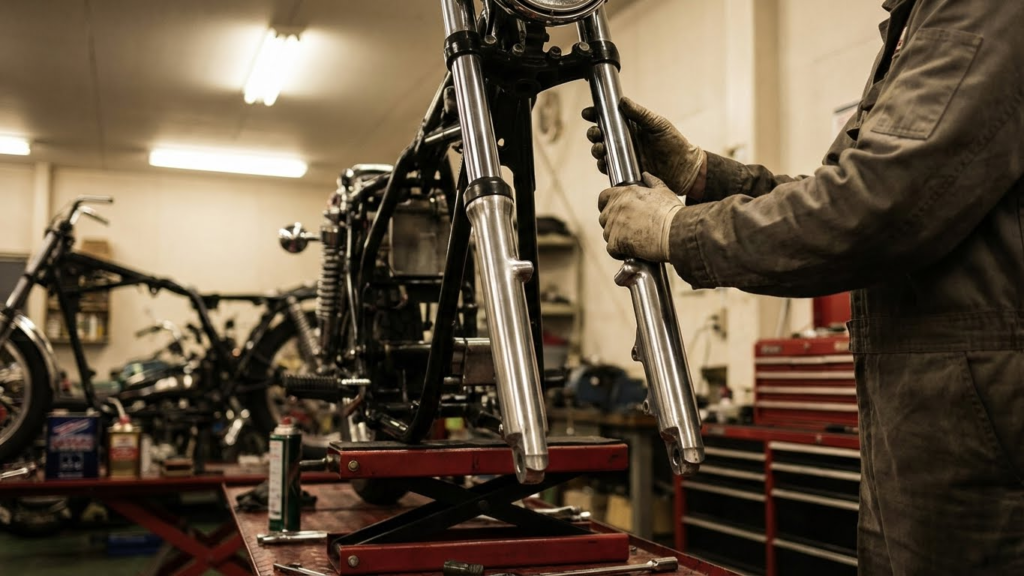
I inspect the front forks, steering head, and rear shock to make sure the bike rides straight, absorbs bumps, and steers without play. I look for leaks, worn parts, incorrect oil levels, and loose or rough bearings.
Fork Oil and Seal Evaluation
I check fork seals for oil drips, pitting, or hardened rubber that causes weeping or puddles on the lower legs. If I find oil residue, I replace the seals and clean the fork stanchions to prevent rapid seal wear.
I measure fork travel and compress the forks to feel for stiction or harsh damping. Soft or spongy action can mean low oil, worn internal bushings, or contaminated oil. I drain and replace fork oil to the manufacturer’s grade and level if damping feels incorrect.
I inspect fork tubes for straightness and surface damage. Bent or deeply scored tubes require replacement to protect new seals and restore correct handling.
Steering Head Bearing Adjustment
I lift the front wheel off the ground to check for play and smooth rotation in the steering head. I feel for clicks, notchiness, or binding while turning the bars through the full range.
I torque and adjust the top yoke nut to the spec, then recheck for free movement without side-to-side play. If bearings are rough or have pitting, I remove and clean the race and replace the bearings and seals.
I grease the bearings with the correct type and amount. Proper lubrication prevents corrosion and keeps steering light and precise.
Shock Absorber Assessment
I inspect the rear shock body and linkage for oil leaks, dents, and worn mounting bushings. Leaking shock oil or collapsed springs require rebuild or replacement.
I test rebound and compression by sitting on the bike and riding short bumps, noting if the shock returns too quickly or too slowly. I adjust preload, damping, and rebound settings to the owner’s weight and riding style when the shock offers external adjusters.
I check swingarm bearings and linkage for play. Worn linkage bearings change shock action and should be replaced to restore consistent suspension feel.
Tyre and Wheel Evaluation
I inspect tyre pressure, tread depth, sidewall condition, wheel bearings, and spoke tension to ensure safe handling and grip. I also check wheel alignment and balance to prevent vibration and uneven wear.
Tyre Pressure and Tread Depth Check
I measure tyre pressure with a calibrated gauge and adjust to the manufacturer’s specified cold pressures found in the owner’s manual or on the swingarm sticker. I note pressures for front and rear separately and record any repeated loss of pressure that could indicate a slow leak or valve issue.
I check tread depth with a ruler or a tread-depth gauge. For road bikes I look for at least 1.6 mm across the central grooves, and greater depth for wet riding. I inspect sidewalls for cuts, bulges, or weather cracking and remove embedded objects like stones or nails.
If tread is uneven, I trace the cause to chain adjustment, suspension setup, or improper pressure. I link to the Motorcycle Safety Foundation for tyre basics and to the TyreSafe guidance for legal tread limits to help riders learn proper standards.
Wheel Alignment and Balancing
I check wheel alignment visually and with measurement tools to confirm the rear wheel sits square to the frame and the chain runs centered on the sprockets. Misalignment shows as the chain pulling to one side, poor handling, or rapid tyre edge wear.
I spin the wheels on the bike or remove them to fit on a static balancer. I look for heavy spots or bent rims and fit wheel weights as needed to stop vibration at speed. For spoked wheels I check spoke tension by feel and with a spoke wrench; loose spokes get tightened and the wheel trued.
I inspect wheel bearings for play and roughness by lifting the bike and rolling the wheel by hand. Any grinding, roughness, or noticeable play usually requires bearing replacement to prevent wobble or failure.
Electrical System Diagnostics
I test the battery, lights, indicators, and charging components to find faults that can stop the bike from starting or make it unsafe to ride. I look for weak cells, poor connections, blown bulbs, and charging output that falls outside the manufacturer’s specs.
Battery Condition Test
I start with a visual check for cracks, leaks, corrosion, and secure mounting. Then I measure resting voltage and perform a load or conductance test to see how the battery performs under demand.
If the resting voltage is below the specified threshold (usually about 12.4–12.6 V for a healthy 12 V battery), I recommend charging and retesting. A load test or conductance readout shows if capacity has fallen even when voltage looks okay.
I also inspect terminals and cables for corrosion, tightness, and heat damage. I clean terminals with a proper cleaner and apply dielectric grease to prevent future corrosion. I record results and advise replacement when capacity is under safe limits or the battery fails a load test.
Lighting and Indicator Inspection
I check every external and dashboard light: headlight low/high, tail, brake, turn signals, license plate, and warning lamps. I verify correct bulb type, brightness, alignment, and that lenses are intact and free of moisture.
For turn signals I measure flash rate and confirm both bulbs and relay/circuit are working. I use a multimeter to check for voltage at the bulb socket when switches are actuated. I replace blown bulbs and repair sockets or wiring that show high resistance or intermittent contact.
I also test switches and connectors for smooth operation and secure mounting. If headlights are dim with the engine running, that often points to a charging issue rather than the bulbs themselves.
Charging System Assessment
I test the charging system with the engine running at the recommended RPM to measure charging voltage and current at the battery. Typical healthy charging systems deliver around 13.5–14.8 V for a 12 V system; values outside this range need attention.
I inspect the stator, regulator/rectifier, and associated wiring for heat damage, loose connections, and signs of oil or coolant contamination. I measure AC output from the stator and DC output after the rectifier to pinpoint where voltage drops or ripple occur.
If I find excessive ripple, low output, or overheating parts, I recommend replacing the faulty component and rechecking under load. I log test values and explain repair options so the owner can make an informed decision.
Fluid Level and Leak Inspection
I check fluid levels and look for leaks that can cause overheating, loss of brakes, or engine damage. I focus on exact fluid types, correct levels, and any signs of seepage around reservoirs, hoses, and gaskets.
Coolant Level Verification
I inspect the coolant reservoir and radiator for the correct level and color. On a cold engine the level should sit between the “MIN” and “MAX” marks on the overflow bottle. If the bike uses a pressurized radiator cap, I only remove it when the engine is cool to avoid burns.
I check the fluid condition next. Coolant should be clear or the manufacturer’s specified color and free of oil, rust, or heavy sediment. Milky or oily coolant often signals a blown head gasket or mixing with oil.
I trace hoses and clamps for soft spots, bulges, and green or white crust where leaks form. I press hoses gently to feel for deterioration and tighten or replace loose clamps if needed. I note any low level and test pressure if I suspect a slow leak.
Hydraulic Fluid Checks
I examine brake and clutch reservoirs for proper levels and fluid condition. Reservoirs should be within marked ranges and free of debris or dark discoloration. Dark, cloudy fluid usually means moisture contamination and needs replacing.
I verify the correct fluid type — DOT3, DOT4, or mineral oil — per the owner’s manual and top up only with the specified fluid. Mixing types can damage seals and reduce performance.
I inspect lines, fittings, and bleed screws for leaks or wetness. I squeeze caliper pistons and actuate the lever to check for a firm, non-spongy feel. If I find soft levers, visible leaks, or contaminated fluid, I schedule a full bleed and fluid change.
Final Safety and Performance Assessment

I check every adjustable control, ride the bike under varied conditions, and verify that brakes, suspension, and engine response meet safety and performance targets. I focus on precise cable freeplay, lever operation, and real-world handling before signing off.
Control Cables and Levers Adjustment
I inspect throttle, clutch, and brake cables for fray, corrosion, and proper routing. I set throttle freeplay so it snaps back smoothly without sticking, and I adjust clutch freeplay to the manufacturer’s spec to ensure full disengagement at the lever.
I check lever pivot points and lubricate where needed to remove stiffness. I measure and set brake lever freeplay for consistent bite and lever travel. I confirm secondary controls — choke, decompression, and cruise linkages — operate without binding.
I test hand and foot levers under load to ensure no slop or excessive play. I record all final clearances and torque values for future reference.
Test Ride and Performance Verification
I perform a controlled test ride that includes low-speed maneuvers, hard braking, steady throttle runs, and rapid acceleration. I listen for unusual noises and watch for vibration, pull, or hunting that indicate alignment, suspension, or fueling issues.
I check brake feel and stopping distance from moderate speeds, watching for fade or uneven bite. I evaluate gear shifts for smooth engagement and confirm the clutch fully releases under load.
I monitor engine temperature, oil pressure (if visible), and throttle response across the rev range. I make minor on-road adjustments if safe, then repeat checks to confirm the bike meets measurable safety and performance targets.
Detailed Documentation and Service Reporting
I record every step of a full service to give a clear history of the work done. I note dates, mileage, and the exact tasks completed, such as oil and filter changes, brake inspections, and valve checks.
I include parts used and their part numbers when possible. This helps future servicing and supports warranty claims if the bike is still covered.
I provide a simple checklist that shows passed and failed items. Bullet lists make it quick to scan:
- Fluids: oil, coolant, brake fluid
- Filters: air, oil
- Wear items: tyres, brake pads, chain
I attach short notes for any repairs or recommended follow-ups. These notes state urgency and estimated costs so owners can decide next steps.
I often include photos of worn parts or problem areas. Images offer clear evidence of condition and make explanations easier to trust.
I keep copies in both paper and digital form. Digital records let me email the owner or store the history for future buyers.
I sign and date the report to confirm accuracy. My clear record helps maintain value and proves proper maintenance over time.
FAQs
How often should I book a full service?
I recommend a full service at major mileage intervals, after long storage, or if you notice handling, braking, or starting issues. Check your owner’s manual for the manufacturer’s schedule.
Will a full service fix every problem?
A full service finds and fixes many common wear items, but it may not cover major repairs or parts replacement beyond wear-and-tear items. I will quote extra work before doing repairs not included in the service.
How long does a full service take?
Typical full services take a few hours to a day, depending on the bike and whether extra work is needed. Complex jobs like valve work or major electrical diagnostics take longer.
What should I do before dropping my bike off?
I suggest removing personal items, noting any specific issues, and checking for warranty or service plans. Clear instructions help me focus on the problems that matter most to you.
Conclusion
I recommend a full service when you want a complete check of your motorcycle’s health. It covers oil and filter changes, brakes, fluids, filters, and a detailed inspection of moving parts and electrical systems.
I value regular servicing because it finds small issues before they become big problems. That saves money and keeps the bike safe and reliable.
If you ride often or plan a long trip, choose a full service. I suggest using a dealer or qualified mechanic who records stamps and signatures in the service book.
Below I list quick reminders to help you decide:
- Book a full service at the intervals in your manual.
- Ask for written details of work done and parts replaced.
- Keep the service record with the bike; it helps resale value.
I prefer clear communication with the technician. Tell them any odd noises or handling changes you’ve noticed and confirm what checks they will perform.